 Debridge finance
 lets authorized accounts cancel unfilled cross-chain orders.
Last updated
Debridge finance leaves unfilled orders available to solvers until cancellation takes effect on the destination chain. Waiting preserves the requested exchange while market conditions change. Cancellation starts the return of locked source funds when the exchange is no longer wanted. The choice depends on the order’s destination status, who controls its cancellation authority, and whether cancellation has already started. A submitted cancellation transaction alone does not establish a completed refund.
Unfilled, fulfilled, and awaiting a source refund require different actions
An unfilled order on the deBridge Liquidity Network (DLN) still awaits destination execution. A fulfilled order cannot enter the ordinary order-cancellation process. After cancellation executes on the destination chain, the order can no longer be fulfilled, but the source refund may remain outstanding. These states determine whether waiting concerns a solver or the return of funds.
When does waiting make sense for an unfilled order?
Waiting preserves an exchange whose terms remain acceptable, especially when a limit order deliberately requires more favorable market conditions.
Solvers evaluate the requested output against their available liquidity, execution expenses, and risk. An unattractive order can remain unfilled even though its creation succeeded. A market quote reflects conditions during quotation; it does not compel a solver to execute later.
Elapsed time alone does not identify the cause. The useful distinction is whether the order remains open, has reached fulfillment, or has entered cancellation.
Cancellation becomes relevant when the intended exchange is no longer acceptable and the order remains eligible. Waiting for a better market and waiting for a refund involve different mechanisms.
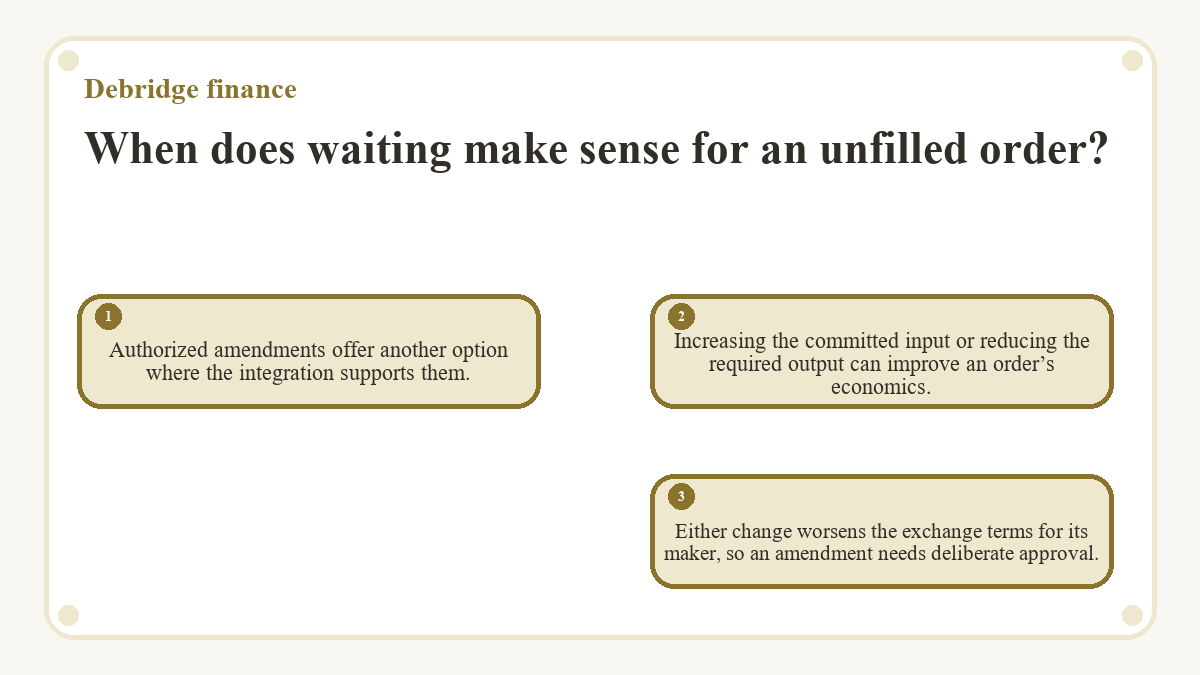
Authorized amendments offer another option where the integration supports them. Increasing the committed input or reducing the required output can improve an order’s economics. Either change worsens the exchange terms for its maker, so an amendment needs deliberate approval.
Cancellation authority and refund destination are separate
The destination cancellation authority determines who may initiate the exit, while the beneficiary determines where the source funds return. Owning the destination receiving account does not automatically establish cancellation authority. API-created orders record these roles separately.
Authority recorded when the order was created
Manual cancellation requires the account designated for that operation on the destination chain. Connecting another account cannot substitute for that authorization. An approved automatic-cancellation integration can assign the role to a service-controlled account, which changes who can submit the transaction.
The permitted source beneficiary
A beneficiary fixed in the order
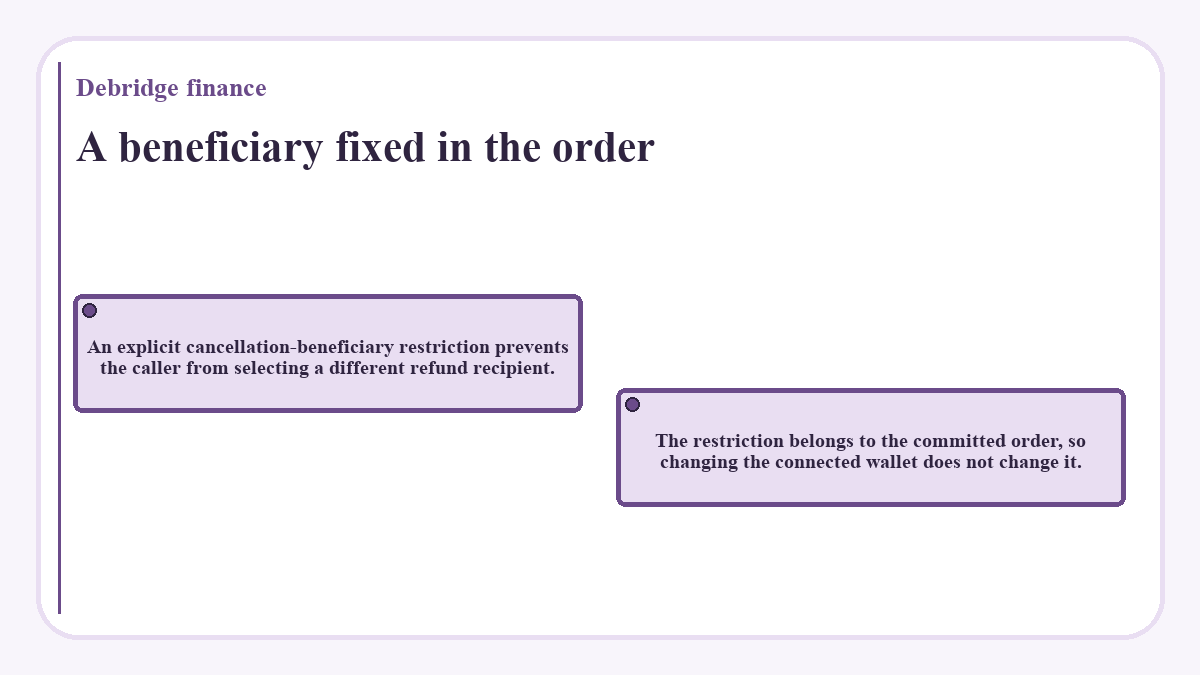
An explicit cancellation-beneficiary restriction prevents the caller from selecting a different refund recipient. The restriction belongs to the committed order, so changing the connected wallet does not change it.
An unrestricted contract-level beneficiary
Where the contract permits an unrestricted beneficiary, the authorized caller supplies the source recipient. An integration may still construct a specific beneficiary automatically. Inspect the actual cancellation payload before signing.
What happens after you choose cancellation?
Cancellation first stops fulfillment on the destination chain, then uses cross-chain messaging to request the source refund.
Consider an existing order with no fulfillment or cancellation recorded. Keeping its terms leaves it available to solvers. Choosing cancellation requires the authorized account and a permitted beneficiary. Once destination cancellation succeeds, the next task changes: track the refund message rather than wait for a solver. The table follows that cancellation path; several operations occur within the same transaction.
| Stage | Operation | Conditions, limits, and recovery |
|---|---|---|
| Prepare cancellation | Construct transaction data for the existing order. | The order must remain eligible for cancellation. |
| Validate the transaction | Match the destination chain, authority, beneficiary, and required value. | Resolve an incorrect account or payload before signing. |
| Sign and submit cancellation | The authorized account signs and broadcasts. | Broadcasting alone does not change the order state. |
| Execute destination cancellation | The contract records cancellation and sends its message. | Successful execution prevents subsequent fulfillment. |
| Validate the cross-chain message | The messaging infrastructure applies its finality and validation requirements. | The source refund still requires message execution. |
| Execute the source claim | The source contract processes the authenticated cancellation instruction. | A failed claim needs investigation at this stage. |
| Confirm returned funds | The source transfer identifies the beneficiary, asset, and amount. | Match the refund to the cancelled order before treating its funds as available. |
| Completed cancellation | Destination fulfillment has stopped. | The matching source refund has executed. |
The cross-chain message connects destination cancellation to source release. Its processing follows the applicable chain finality requirements, so the destination transaction and refund need separate confirmation.
Refunded order funds and cancellation expenses differ
The refund covers the funds that the source contract holds for the cancelled order. DLN cancellation returns the locked order funds, including the associated affiliate and protocol fees. On EVM deployments, the source refund calculation also includes additional input committed through an order patch.
Cancellation has its own transaction costs. A manual API cancellation payload includes native-currency value for messaging and source execution incentives, alongside the destination transaction’s gas requirement. The locked balance does not replace that funding requirement. Review the transaction’s required value and network gas estimate instead of assuming that a fee refund makes cancellation free.
Does every unfilled order cancel automatically?
Automatic cancellation applies only to eligible market orders associated with a referral code through integrations that have deBridge approval and enable the service. It does not extend to limit orders. The integration assigns destination cancellation authority to a service-controlled address, and deBridge subsidizes cancellation costs. Timeout behavior belongs to that service configuration; it is not a universal expiration rule for all DLN orders. The refund beneficiary must still identify the intended source account.
A rejected cancellation needs a different response from an unfinished refund
A failed destination transaction leaves a different problem from a successful cancellation awaiting source execution. Wrong-chain submissions, an unauthorized caller, and a prohibited beneficiary can prevent cancellation. Repeating unchanged transaction data will not correct those conditions. Read the failure alongside the order’s latest destination state before deciding whether another attempt remains valid.
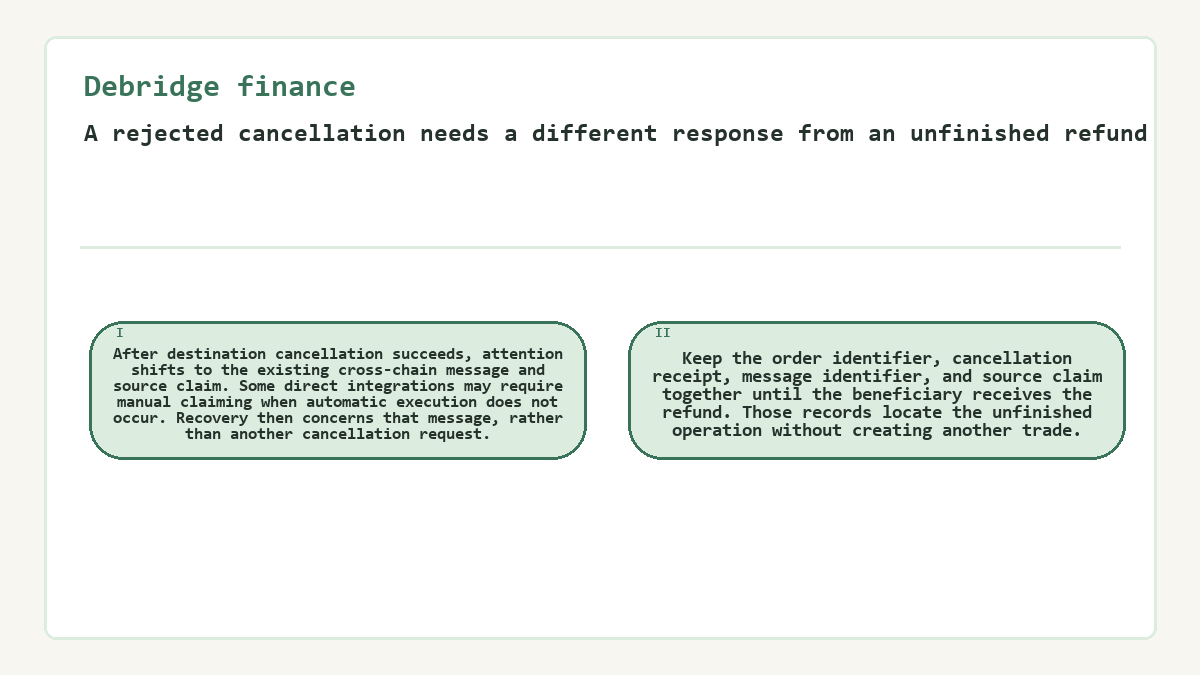
After destination cancellation succeeds, attention shifts to the existing cross-chain message and source claim. Some direct integrations may require manual claiming when automatic execution does not occur. Recovery then concerns that message, rather than another cancellation request. Keep the order identifier, cancellation receipt, message identifier, and source claim together until the beneficiary receives the refund. Those records locate the unfinished operation without creating another trade.
Still have questions?
-
What happens if a solver fills the order while my cancellation is pending?
- A successful fulfillment before cancellation takes effect makes ordinary cancellation unavailable. The destination contract checks the order state when it executes the transaction. A wallet signature or broadcast does not reserve the right to cancel ahead of a solver.
-
Is requesting cancellation transaction data enough to stop an order?
- Requesting transaction data does not cancel the order. The API constructs a payload that the authorized account must sign and submit on the destination chain. Until successful execution changes the order state, the data response provides no evidence that fulfillment has stopped.
-
Will cancellation return the token that I originally selected?
- Cancellation returns the asset committed to the order, which can differ from the token initially selected if a source swap occurred first. For API-created orders, the creation response identifies that asset in srcChainTokenOut when present; otherwise, srcChainTokenIn identifies it. Cancellation does not reverse the earlier swap.
-
Can a fresh quote improve an order that is already waiting?
- A fresh quote alone does not amend an existing order. Supported contract amendments require an authorized on-chain operation, such as adding input or reducing the requested output. A quote can inform that choice, but obtaining one does not change the terms that solvers can fulfill.
-
Do I lose cancellation access if I lose control of the authority account?
- Manual cancellation requires control of the destination authority recorded for the order. Another receiving or source account does not automatically inherit that permission. Losing access to the authority can therefore leave the manual cancellation path inaccessible, even when another account belongs to the same person.